
Beyond the Fine: The Catalyst Care Story That Deserves a Fuller Hearing
Beyond the Fine: The Catalyst Care Story That Deserves a Fuller Hearing
By FeroMedia
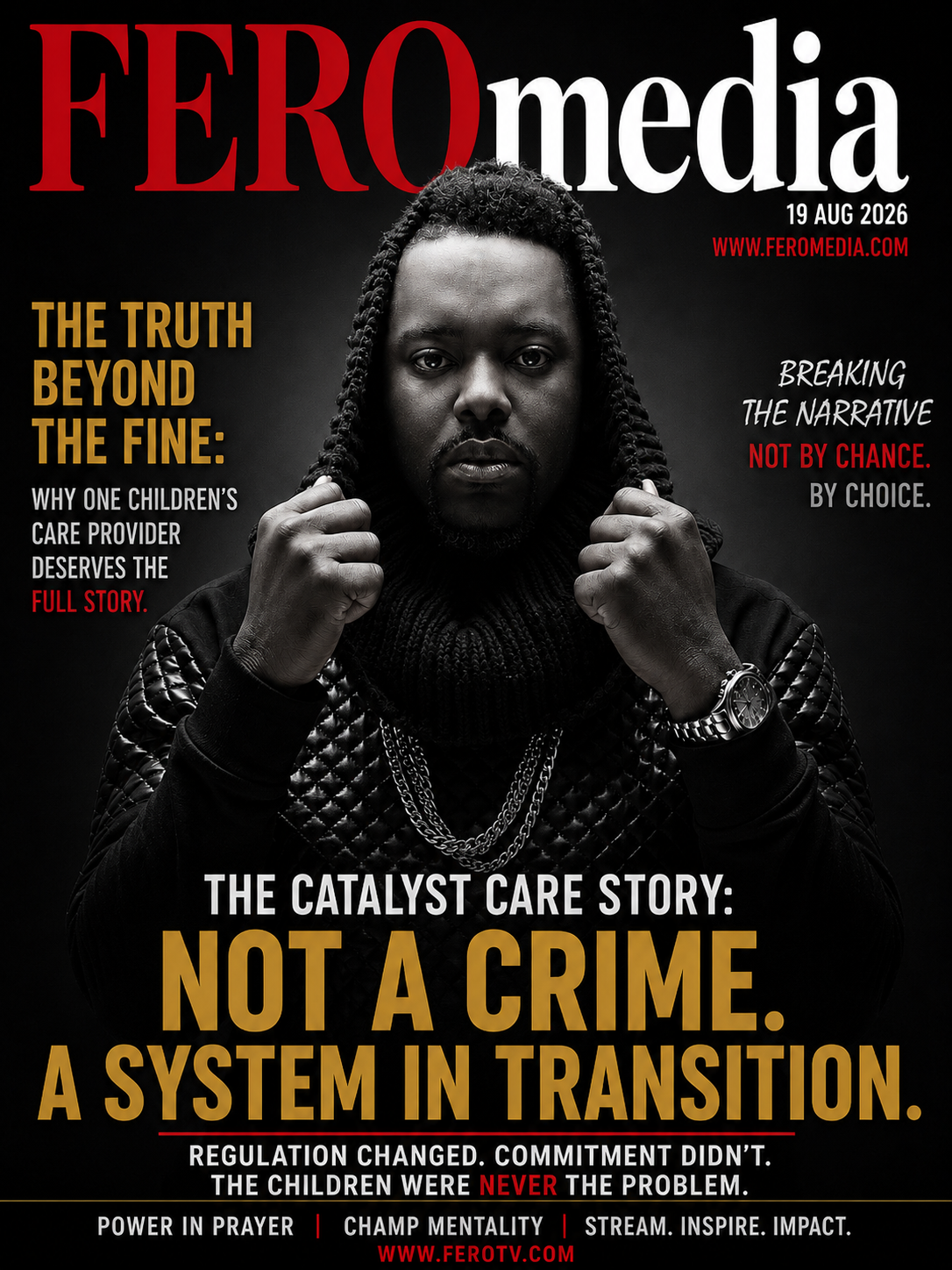
A headline can tell you what happened. It cannot always tell you why it happened, what came before it, or what happened to the people at the centre of the story.
That is the concern with recent reporting about Catalyst Care Ltd, a New Addington-based children's care provider.
The headline is striking: a children's home company fined more than £100,000.
The regulatory breach is a legitimate matter of public interest. Catalyst Care and its directors pleaded guilty to offences relating to the operation of children's homes without the required registration, and the company was subsequently fined.
But if the public is going to understand what happened, the story cannot begin and end with the fine.
There is a much bigger story to investigate — one involving changes to children's social-care regulation, the registration process, local authorities placing children with providers, and, most importantly, the actual quality and safety of the care those children received.
A regulatory landscape that changed
One important piece of context is the significant change to the regulatory framework in 2023.
The Supported Accommodation (England) Regulations 2023 introduced a new Ofsted registration and regulatory regime for supported accommodation for looked-after children and care leavers aged 16 and 17. Providers were able to begin registering under the new system from April 2023, with mandatory registration coming into force later that year.
This was a significant change to an already complex children's social-care system.
The introduction of a new regulatory framework inevitably meant that providers, councils and regulators had to navigate new requirements, new classifications and new registration processes.
That does not mean that registration requirements can simply be ignored.
They cannot.
Ofsted's position is clear: where registration is legally required, operating without it is an offence, including while an application is being processed.
That legal requirement must be acknowledged.
But acknowledging it does not mean that every aspect of the story should be reduced to the word "illegal".
There is a difference between a regulatory offence concerning registration and an allegation that children were being abused, neglected or placed in danger.
Those distinctions matter.
What does the fine actually tell us?
The public reporting establishes that Catalyst Care was prosecuted over its registration status and that the company pleaded guilty.
The company was fined £92,400, with additional costs and surcharges reported, taking the total financial consequences to more than £112,000.
That is significant.
But what exactly does the fine tell the public?
It tells us that the organisation was found to have operated homes without the registration that the law required.
It does not, by itself, tell us that children were abused.
It does not, by itself, tell us that children were neglected.
It does not, by itself, tell us that children were unsafe.
And it does not answer the much more fundamental question of what the children's experience actually was.
Those questions require evidence.
The quality of care: the question the reporting must answer
What is largely missing from the reporting is any clear account of whether there were concerns about the actual quality or safety of the care provided. The coverage establishes the regulatory breach, but rarely addresses whether children were harmed, neglected, placed at risk, or otherwise received poor care.
That omission is important.
When the subject is children's care, the first question should surely be about the children.
Were they safe?
Were they appropriately supervised?
Were their individual needs being met?
Were there safeguarding concerns?
Were there complaints?
Were there incidents involving harm or neglect?
What did social workers and placing authorities think about the standard of care?
And what did the regulator actually observe?
These questions should sit at the heart of the story.
A registration breach is a serious matter. But it should not automatically be presented as evidence of poor care unless there is evidence connecting the two.
If children were harmed or placed at risk, the public deserves to know.
But if there is evidence that children were receiving good care, that matters too.
A genuinely holistic account must examine both.
Why were local authorities placing children there?
There is another question that deserves much greater attention.
If local authorities were placing vulnerable children with a provider, why were they doing so?
What due diligence had been carried out?
What assessments had been undertaken?
What information did councils have about the organisation?
Were social workers satisfied with the care being provided?
Were children making progress?
Were there positive reports or assessments?
Were councils aware of the registration position?
And if there were concerns about registration, why did placements continue?
These are not questions designed to excuse a regulatory breach.
They are questions designed to understand the system.
Local authorities have legal responsibilities towards children in their care. They also face enormous pressure to find suitable placements, particularly for children with complex needs.
That wider context should be part of the story.
The missing distinction: registration versus care
One of the biggest dangers in reporting cases like this is allowing readers to assume that "unregistered" automatically means "unsafe".
The two concepts are related, but they are not identical.
Registration exists precisely so that children's homes can be subjected to regulatory scrutiny and oversight.
Operating without the required registration is therefore serious.
But the fact that a provider was not properly registered does not, without further evidence, establish that every child in that provision received poor care.
That distinction is especially important when reporting about organisations that have continued to work with local authorities and vulnerable children.
The public deserves precision.
If there were safeguarding failures, report them.
If there were serious concerns about care, report them.
If children were harmed, report it.
But if the prosecution concerned registration, then say that clearly too.
Don't allow a regulatory offence to become something that it wasn't.
What about Ofsted?
This is another area where the story deserves greater investigation.
Any claim that Ofsted regarded the organisation or its care as "brilliant", "outstanding" or otherwise highly positive should be supported by documentary evidence, such as inspection reports, correspondence or official assessments.
If such evidence exists, it should be included.
If it does not, journalists should not make the claim.
But equally, if there were positive observations, assessments or evidence of good outcomes for children, those should not disappear simply because a later regulatory prosecution provides a more dramatic headline.
The public deserves the complete regulatory history.
That means looking at what happened before, during and after the registration dispute.
The £1.8 million question
The reporting also highlights the fact that Catalyst Care received more than £1.8 million from local authorities during the period in question.
That is certainly worthy of scrutiny.
But again, the question should not simply be:
"Why did councils pay this company?"
It should also be:
"What were councils paying for, and why did they believe the placements were appropriate?"
How many children were placed?
For how long?
What services were provided?
What did those placements cost compared with alternative provision?
What assessments were undertaken?
What did councils know about the registration status?
And what outcomes did the children experience?
Those questions could tell the public far more than simply reporting the total amount of money involved.
A wider crisis in children's social care
Catalyst Care is not operating in a vacuum.
England's children's social-care system is under enormous pressure. There are shortages of suitable placements, particularly for young people with complex needs, while local authorities are under financial and operational pressure.
Ofsted has itself reported significant numbers of potentially unregistered children's homes and has highlighted the scale of the challenge facing the sector.
That does not make operating without registration acceptable.
But it does raise an uncomfortable question:
Are regulatory breaches sometimes symptoms of a wider system struggling to provide enough suitable accommodation for vulnerable children?
If councils cannot find enough registered placements, providers and local authorities can end up operating within a system under immense pressure.
Understanding that pressure does not remove individual responsibility.
It helps explain the environment in which these cases occur.
Good journalism must provide the whole picture
There is nothing wrong with reporting the prosecution of Catalyst Care.
There is nothing wrong with reporting the guilty pleas.
There is nothing wrong with reporting the fine.
Those are matters of public record and deserve scrutiny.
But responsible journalism should also ask what happened to the children.
It should examine the registration process.
It should examine the regulatory changes introduced in 2023.
It should examine the relationship between the provider and local authorities.
It should examine whether there were safeguarding concerns.
And it should examine any evidence concerning the actual quality of care.
Because there are two very different stories that can emerge from the same set of facts.
One story is:
"Children's home company fined more than £100,000."
The other is:
"What happened when a children's care provider operated during a changing regulatory landscape — and what did the children experience?"
The second question is harder.
But it is also more important.
The children should remain at the centre
Ultimately, this should not be a story about protecting a company from criticism.
Nor should it be a story about defending a regulatory breach.
If Catalyst Care broke the law, that should be acknowledged.
If the directors made mistakes, those mistakes should be examined.
If children were harmed, the public deserves the truth.
But if children were safe, supported and receiving good care, that deserves to be part of the public record too.
The media has a responsibility not simply to report the most damaging part of a story, but to investigate the circumstances that produced it.
Because when vulnerable children are involved, the question should never be simply:
"Who was fined?"
It should be:
"What happened, why did it happen, who knew, what did the regulators and councils do, and most importantly — what happened to the children?"
That is the story worth investigating.
That is the story the public deserves.
And that is the difference between reporting an event and understanding it.










 Loading...