
FAUCI CONTEMPT VOTE
FAUCI CONTEMPT VOTE
The Senate Committee Vote That Reignited America's Biggest COVID Debate
By FEROmedia Political Desk
August 2026
For many Americans, Dr. Anthony Fauci became one of the most recognizable public officials in modern history. During the COVID-19 pandemic, he was praised by millions as a trusted public health expert while simultaneously becoming one of the most criticized figures in American politics.
Years after the pandemic officially ended, the political battle surrounding his decisions has shown no signs of disappearing.
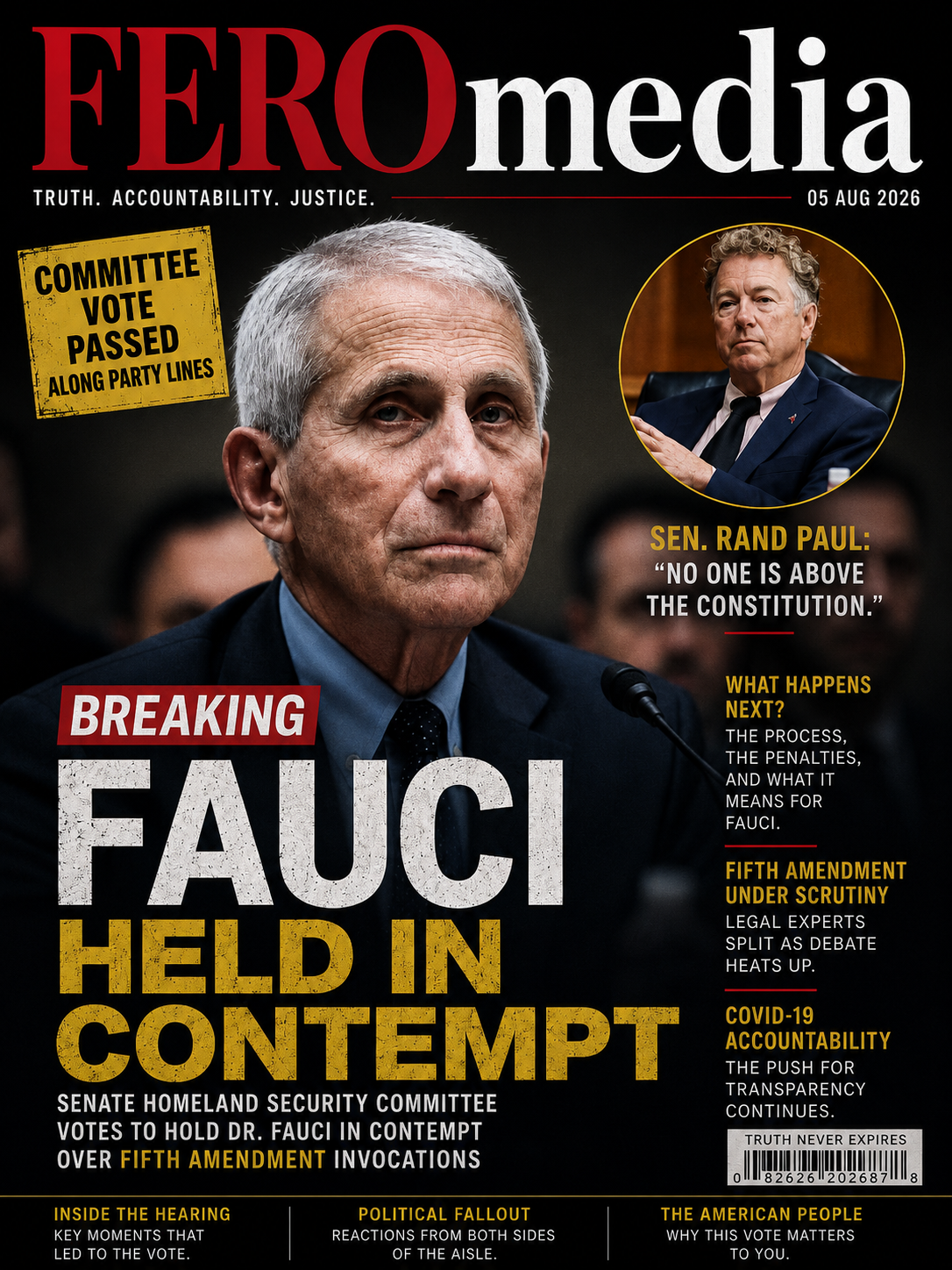
This week, that conflict entered another dramatic chapter when the Senate Homeland Security and Governmental Affairs Committee, chaired by Senator Rand Paul, voted to hold Dr. Anthony Fauci in contempt of Congress after he repeatedly invoked his Fifth Amendment rights during testimony.
The committee's vote immediately dominated political headlines across the United States, triggering fierce debate among legal scholars, politicians, scientists and the public.
But what exactly happened—and what does it actually mean?
A Hearing Years in the Making
The hearing was designed to examine longstanding questions surrounding the government's response to COVID-19, including:
- Federal funding for virus research
- Gain-of-function investigations
- Public health messaging
- Vaccine policies
- Lockdowns
- Mask mandates
- Government transparency
Many Republican lawmakers have argued for years that Americans deserve greater accountability regarding pandemic-era decisions.
Democrats, meanwhile, have maintained that many accusations against Fauci have been politically motivated and unsupported by evidence.
The hearing represented one of the most anticipated confrontations since the pandemic ended.
The Fifth Amendment Decision
Rather than answer many of the committee's questions, Dr. Fauci repeatedly invoked his constitutional right under the Fifth Amendment.
The Fifth Amendment protects individuals from being compelled to provide testimony that could incriminate themselves in criminal proceedings.
Invoking the Fifth Amendment does not by itself establish guilt, nor is it illegal. It is a constitutional protection that has been used throughout American legal history by witnesses in a wide variety of investigations.
However, Senator Rand Paul argued that Fauci's reliance on the Fifth Amendment should not shield him from congressional accountability and questioned whether the circumstances justified its use.
That disagreement became the central issue of the hearing.
The Committee Vote
Following the testimony, the Senate committee voted along party lines to hold Fauci in contempt of Congress.
Supporters of the vote argued that:
- Congress cannot effectively conduct oversight if key witnesses refuse to answer questions.
- Americans deserve complete transparency regarding pandemic decision-making.
- Public confidence requires accountability from senior officials.
Opponents countered that:
- Constitutional rights apply equally to every citizen.
- Invoking the Fifth Amendment cannot itself be treated as wrongdoing.
- Political disagreement should not override established legal protections.
The committee's decision marked one of the most politically significant moments involving a former federal health official in recent memory.
What "Contempt of Congress" Actually Means
Despite dramatic headlines, the committee's vote does not mean Dr. Fauci has been convicted of a crime.
Instead, the vote is a congressional action that may begin additional legal or procedural steps.
Whether further action occurs depends on subsequent legal processes and the decisions of the relevant authorities.
In other words:
- The committee voted to pursue contempt proceedings.
- It is not a criminal conviction.
- It does not automatically result in penalties.
This distinction has often been lost in social media discussions.
Rand Paul's Long Campaign
Senator Rand Paul has spent years questioning Fauci's handling of COVID-19.
Their public disagreements became some of the most watched Senate exchanges during the pandemic.
Paul has consistently argued that:
- Government agencies failed to provide sufficient transparency.
- Americans were misled regarding aspects of pandemic policy.
- Congress has a responsibility to investigate these matters thoroughly.
For Paul, the committee vote represents another step in what he views as a broader effort to obtain accountability.
Fauci's Supporters Respond
Supporters of Dr. Fauci argue that his decades of public service should not be overshadowed by political controversy.
They point to:
- His leadership through multiple public health crises.
- His role advising several U.S. presidents.
- Scientific guidance developed during an unprecedented global emergency.
Many also stress that invoking constitutional protections should not be portrayed as an admission of guilt.
Legal experts remain divided over the implications of the hearing and the committee's actions.
America Still Divided
Perhaps more than any single public official from the pandemic era, Fauci remains a symbol of the broader national divide.
For some Americans, he represents science under extraordinary pressure.
For others, he symbolizes government overreach during one of the most disruptive periods in modern history.
The committee vote has once again exposed just how differently Americans continue to interpret the events of the COVID-19 years.
The Bigger Picture
Regardless of political affiliation, the hearing highlights enduring questions that continue to shape public debate:
- How should Congress oversee executive agencies?
- When should public officials invoke constitutional protections?
- What level of transparency should Americans expect during national emergencies?
- How can public trust be rebuilt after deeply polarizing events?
These questions extend far beyond one witness or one hearing.
What Happens Next?
The committee's vote is unlikely to be the final chapter.
Potential next steps may include additional congressional proceedings, legal review, or other actions by the relevant authorities. At the same time, Fauci's legal team is expected to continue arguing that his invocation of the Fifth Amendment was a lawful exercise of a constitutional right.
Whatever follows, the hearing has already become another defining moment in the long political aftermath of COVID-19.









 Loading...